
Coach the managment
Providing expert advice grounded in social psychology and systemic communication
It also means:
Facing others within relationships shaped by asymmetry and constraints.
Interacting with, facilitating and motivating people who do not always share your views.
Navigating the organisation’s conflicting or sometimes illusory demands.

How we feel the coaching should look like :
At Co-addev, supporting you means shedding light on the situations you experience, re-examining assumptions about management, and above all, proposing approaches tailored to your needs and objectives, drawing on the tools and insights of social psychology.
Communicate
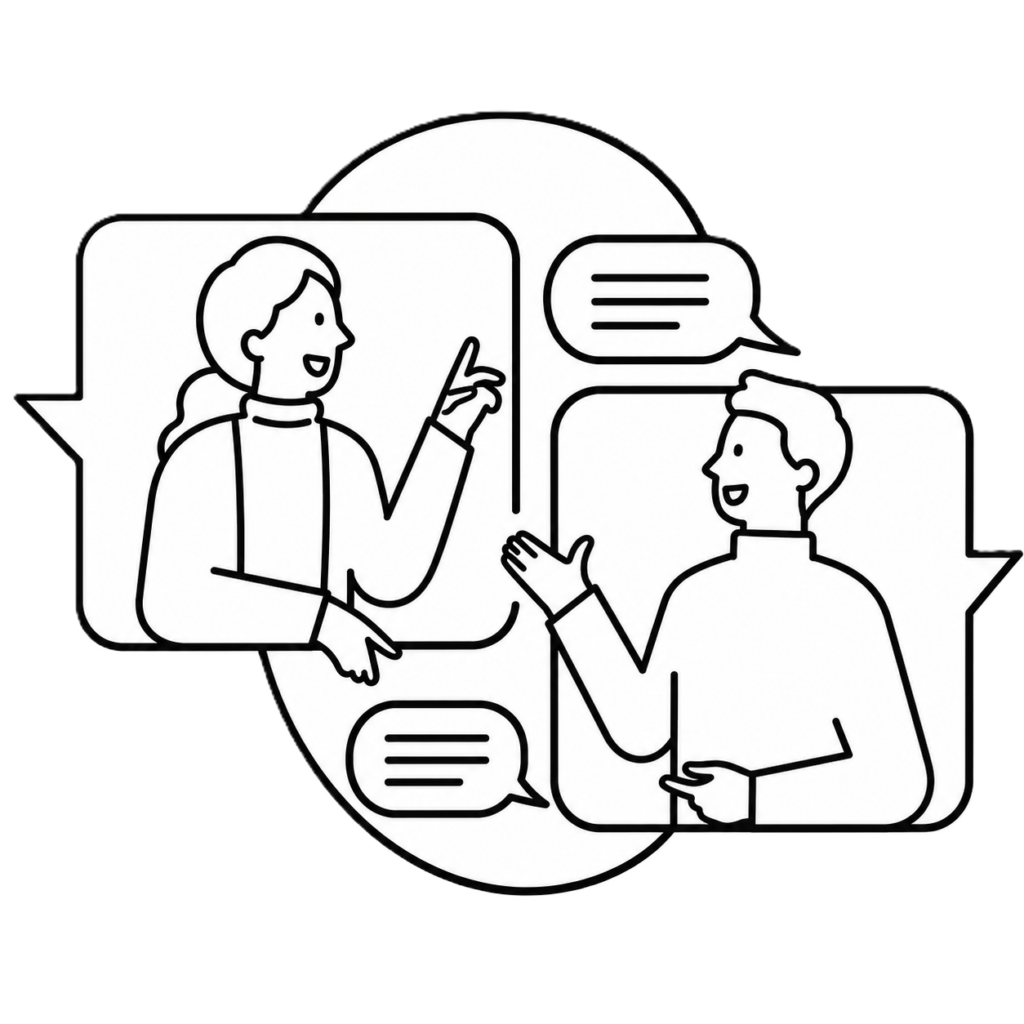
Hear what others leave unsaid and understand how our messages are received.
We approach communication from two complementary perspectives:
- Systemic: Developed from Gregory Bateson’s work and further elaborated by the Palo Alto School, this approach examines behaviours and exchanges in the context of the system that underpins them, including the interests at stake, interactions and feedback loops.
- Psychosocial: This approach draws on fundamental social needs to shed light on relationships and the communication patterns that develop within them.
Perceiving stakes
Be aware of your own motivations and interests, and understand those at play within the system.
Every organisation is a system in which each individual acts according to their own interests and stakes, whether consciously or unconsciously.Mapping these underlying drivers, recognising how they evolve, and becoming aware of those that influence you can help prevent ego-driven behaviour, anticipate potential sources of conflict, and act in line with your values rather than your needs.
Accepting alterity

Recognise others by understanding the values that shape their behaviours and beliefs.
The false consensus bias highlights our tendency to assume that others perceive, believe and behave as we would.Recognising the otherness of those around us means accepting that our perspective is not the only one — and, above all, that it may be flawed or biased.
Copying with emotion

Decode emotions as valuable information and learn to listen to your own.
Emotions are often dismissed as mere by-products of the body, something best ignored, suppressed or devalued. Yet they are, above all, a condensed and heuristic source of information about how we perceive situations.They also act as an early warning system, alerting us when something is not working as it should.Learning to listen to our emotions helps us better understand our reactions, the situations we face and the people around us.
Play with uncertainty and fear

Accept uncertainty to manage it more effectively
Predicting the future, anticipating events and mitigating risks: throughout history, people have sought to free themselves from uncertainty and the unknown.Organisations are no exception. In their pursuit of control, they surround themselves with procedures, risk management frameworks and forecasting systems. Yet, in their wake, employees can learn to fear uncertainty, avoid it or resist it.But uncertainty is everywhere, even when we do our best to manage it. At Co-addev, we help you learn how to navigate it when the dams break and procedures are no longer enough.